
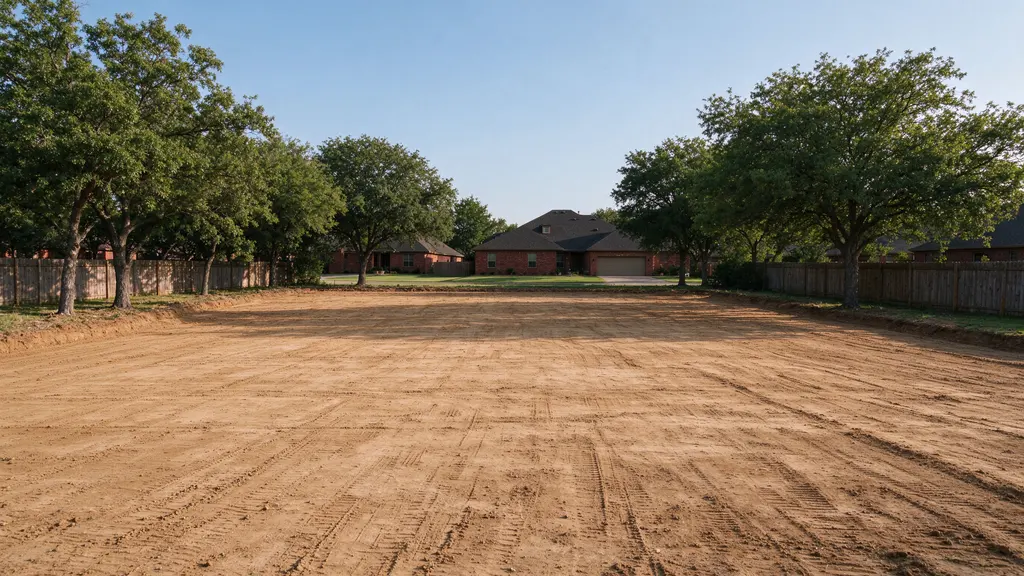
Your finished grade has to work beyond the excavation
Little Elm's Engineering Design Standards call for grading plans showing existing and proposed contours for land-disturbance activities. They also prohibit changing surface-water flow in a way that damages adjoining property. For complex residential grading, the standards describe individual engineered lot plans coordinated with surrounding lots, with an engineer's as-built letter before final inspection.
Our practical starting point is the drawing that establishes the intended result. A homeowner may describe a low backyard, while a builder describes a pad elevation. Those descriptions can lead to different cuts, different fill and different disposal needs. We need the endpoint defined before converting the request into truckloads or equipment time. The Town determines the applicable review requirements; we perform the agreed earthwork rather than supplying engineering design.
Three questions before bringing in fill
What will the new ground support? Where can rainwater leave? How will the new surface meet the ground that stays? Answering those questions helps prevent a fill delivery from becoming a second excavation job. Raising one patch without considering its edges can produce an abrupt change beside a fence, walkway or neighboring lot.
For fill placement, identify whether the material belongs beneath construction or in a nonstructural landscape area. Those uses do not automatically accept the same soil. If the proposed fill supports a pad, the geotechnical recommendations and grading design should describe suitable material and the required placement conditions. A load described simply as clean dirt is not a complete material specification.
The third question concerns the material you already have. Excavated soil may be usable in an approved part of the project, but it should not be spread wherever space happens to be available. A cut-and-fill plan needs both a quantity and a permitted destination. Our guide to cut and fill versus importing soil explains why balancing volumes comes after deciding material suitability.
Make the edge conditions visible
An estimate for grading should identify where the work stops. Show the relationship to the house, driveway and adjoining ground rather than outlining only the center of the proposed change. If a swale must remain open, mark it on the plans. If there is a designed transition along the boundary, the excavation needs enough room to form it.
For a tight side yard, width affects more than machine selection. The work may need space for excavation, material movement and the final grade within the same corridor. A machine that fits through the gate may have little room to turn or load. Tell us about those restrictions when requesting tight-access excavation, and include a photograph looking back toward the street.
Existing structures matter too. Excavation near a foundation requires a defined limit and an appropriate project-specific approach. We do not assume that removing a small amount of soil beside a wall is harmless. If your plans leave that detail unresolved, it needs to be settled before the excavation scope is final.
Have plans?
Let’s define the earthwork.
Additions, pools and driveways need different handoffs
For an addition, foundation excavation follows the supplied footprint and cut details. The next contractor needs the excavation in the agreed condition, with required checks completed before covering work. If the scope includes building pad preparation, the material and acceptance requirements extend beyond merely cutting to a line.
With pool excavation, the pool builder establishes the layout and excavation requirements. We need to know what soil leaves the property and what, if anything, stays. Pool construction, plumbing and equipment installation are separate. Surplus soil should not be used to raise the surrounding yard unless the project design allows that change.
Driveway excavation has another endpoint: a subgrade ready for the specified surfacing work. Confirm the thickness and type of the layers that follow so the cut leaves room for them. A paving contractor's finished surface elevation is not the same as the excavation elevation. Keeping that distinction clear helps the two scopes meet without a last-minute recut.
Plan for the time between rough and finished ground
Earthwork does not always reach its final condition in one visit. A contractor may need access after the rough grade is established, or deliveries may cross an area that will be finished later. Identify those routes before fine grading begins. Otherwise the proposal may assume a final pass that the construction sequence immediately disturbs.
Our rough versus finish grading guide explains that distinction. Rough work establishes the broader shape and elevations; the specified finish refines the surface for its next use. The proposal should say which condition is included and whether another visit is anticipated. A neat-looking surface alone does not establish that the underlying fill meets its requirements.
Temporary stockpiles need thought during that interval. They take up working space, can interfere with drainage paths and may need protection against sediment movement. Erosion and stormwater controls belong in the construction sequence. Assign their installation and upkeep so each trade knows what must remain in place while work progresses.
Compare the whole soil-handling scope
Two excavation prices may be based on different destinations for the soil. One may leave a pile onsite; the other may include loading and export. Ask for dirt removal to be identified separately where it is part of the project. The receiving location, transport and handling conditions affect the work even when the hole dimensions are identical.
For budgeting context, broad Dallas-area residential excavation projects are reported at $1,313–$4,540. That is not a Little Elm rate, a quote for your property or a dependable budget for every pad, pool or commercial site. Use it as broad context only. The estimate needs the actual depth, access, material requirements and restoration responsibilities.
Our excavation cost and volume estimator helps organize measurements. Geometric volume describes the cut before excavation; it does not automatically equal a loose truck volume or a compacted fill quantity. Ask how each quoted quantity is measured before comparing unit prices. Do not multiply a removal rate by a geometric volume without confirming that both describe the same work and volume basis.
What to send for your Little Elm project
Send the address, the proposed use and any grading drawing or survey already available. Photographs should show the work area and the way equipment would reach it. If water is part of the concern, describe what you observe and where it goes, without entering a drainage structure or an excavation to investigate.
We can review residential excavation and commercial earthwork requests with incomplete early information, but missing design decisions remain unresolved until the appropriate project professional addresses them. We do not offer land clearing, drainage-system repair or utility installation. When your project needs those services, keep their responsibilities separate from our excavation scope.
Before scheduling, establish who arranges approvals, locating, layout and specified tests. At completion, compare the agreed earthwork condition with the receiving trade's requirements. That is a more useful definition of finished than simply saying the equipment has left. Our guide to comparing excavation quotes can help you put those obligations beside the price.
Questions before the work.
Can a Little Elm grading project stop at my fence line?
The work limit may be at the fence, but the design still needs to account for adjoining ground and drainage. Little Elm's standards require coordination with surrounding lots for complex individual grading plans. A fence is not evidence that the neighboring elevations can be ignored.
Does a low area mean I should order fill immediately?
No. First establish the desired grade and a workable outlet for surface water. Filling the depression without that context may move the problem somewhere else. Material suitability and the approved placement area then determine what fill belongs in the project.
What budget should I use for excavation at a Little Elm home?
A broad Dallas-area residential excavation range is $1,313–$4,540, but it is regional context rather than a Little Elm quote. Work type, access, cut depth, export and imported fill can make a particular project materially different. Ask for the exact scope behind the proposed total.
Will the yard be finish-graded before the other contractors arrive?
Only if that sequence is appropriate and included. Heavy deliveries or later construction can disturb finished ground. The scope should distinguish the rough-grade handoff from any later finishing visit.
Can leftover pool soil be spread across the rest of the property?
Only where its suitability and the project design allow it. Retaining soil changes elevations and quantities elsewhere. We agree on the stockpile, reuse or removal destination before treating the surplus as part of the plan.